How to Cut Glass Sheets with Minimum Waste
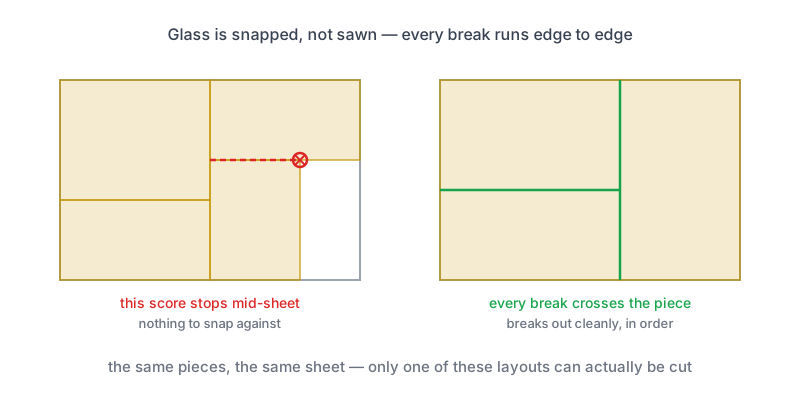
A glazier runs a shopfront order through a nesting program borrowed from the sheet-metal shop. It reports 94% yield, which is better than anything the cutting table has ever produced. On the table it turns out that four of the pieces need a score that starts at an edge and stops halfway across the sheet, and there is no way to snap them. The layout is not merely inconvenient; it is impossible, and the 94% was never real.
What you’ll learn in this guide:
- Why glass cutting is a guillotine problem and what that rules out
- The kerf and trim settings that are right for a scoring wheel rather than a saw
- Which glass can be turned to fit and which cannot
- Where optimization stops and the tempering furnace begins
Why Is Cutting Glass a Guillotine Problem?
Because glass is separated by snapping, and a snap needs a line that crosses the whole piece.
A cutting wheel does not remove glass. It puts a controlled fissure into the surface, and the sheet is then bent along that fissure until it runs through the thickness. For that to work, the score has to reach both edges of whatever is being broken — otherwise there is nothing on the far side to lever against, and the break wanders off the line and takes the piece with it.
That is exactly the definition of a guillotine cut: every cut runs edge to edge and splits the piece in two. For a panel saw it is a machine limitation. For float glass it is physics, and no amount of clever nesting gets around it.
The practical consequence is that yield figures from free-shape nesting tools are meaningless here. A layout with an L-shaped remnant or a piece tucked into a pocket is not a slightly worse plan for glass — it is not a plan at all.
How Is Cutting Glass Different from Cutting Wood?
The geometry is the same 2D problem. Four of the inputs are not.
| Input | Sheet goods | Glass | Why it matters |
|---|---|---|---|
| Kerf | 3–4 mm per cut | Effectively zero | Glass loses no material — a saw kerf setting inflates every gap |
| Cut path | Guillotine or free | Guillotine only | A score that stops mid-sheet cannot be snapped |
| Grain | Fixes orientation on visible faces | None on clear float | Remnants can be turned any way they fit |
| Coating / pattern | Decor face | Fixes which side faces out | Coated pieces cannot be flipped to make them fit |
| Offcuts | Degrade, get lost, warp | Keep indefinitely | The rack is genuinely worth searching first |
| Rework | Recut slightly smaller | Impossible once toughened | The cost of an error is the whole piece |
The kerf difference is the one people get wrong most often, because the optimizer they are using was built for wood and arrives with 3 mm already in the box. On a sheet holding thirty pieces that is thirty phantom gaps, and the plan quietly asks for more glass than the job needs. A glass cutting optimization tool built for the material defaults the kerf to zero and enforces the guillotine constraint, so the plan matches what the cutting table can actually break.
What Kerf and Trim Should You Set?
Kerf zero, trim whatever your table and your supplier’s edges require.
Set the kerf to zero because scoring removes no material. If your shop deliberately leaves a working gap between pieces — many do, to give the running pliers somewhere to sit — then enter that gap as the kerf instead. What matters is that the number reflects a decision rather than a default inherited from a saw.
Trim is the opposite: it matters more for glass than for board. The outer edge of a delivered sheet has been handled, stacked and moved on a rack, and the last 10 to 20 mm carries chips and edge damage you cannot see until the piece is in a frame. Exclude a margin all the way round, and set it from the condition of the glass you actually receive rather than from a catalogue figure.
Trim and kerf do different jobs and are not interchangeable. Trim is taken once at the edge of the sheet; kerf is taken between every pair of pieces. Adding your edge margin to the kerf spreads a single edge allowance across the whole layout and costs far more glass than it saves.
Which Glass Can Be Turned to Fit?
Clear float, freely. Anything with a face or a direction, not at all.
Clear float glass has no grain and no orientation, which makes it the easiest material there is to nest — every piece may be rotated 90 degrees, and remnants keep their full value because they can serve any future job in that thickness. This is a genuine advantage over timber, where a rotated visible part reads visibly crossways.
Three families break that rule:
- Coated glass. A low-emissivity coating sits on one face and must end up on a specific surface of the finished unit. Soft-coat glass also needs the coating removed at the edges before sealing. A coated piece has a front and a back, so it cannot be flipped.
- Patterned and textured glass. The pattern has a run direction, and two adjacent panes cut at ninety degrees to each other look like a mistake, because they are one.
- Mirror. The silvered face is the back, and the backing paint is easily damaged. Handling and orientation both matter.
In an optimizer this is the same control that wood uses for grain: lock rotation on the parts that have a face, leave it free on the rest. Locking everything by reflex costs yield for no reason on the clear float that makes up most of a typical job.
How Do You Set the Job Up?
Five steps, and the first one is the one most often skipped.
Group by type, thickness and coating
Only pieces of the same glass can come from the same sheet. Split the job by product first — 4 mm float, 6 mm toughened blank, low-E, mirror — and optimize each group against its own stock.
Set kerf to zero and trim to your table
Scoring removes no material, so the kerf is zero. What you do need is the trim: the outer edge of a stock sheet is handled, chipped and unreliable, so exclude a margin all the way round.
Keep the layout guillotine
Every break must run edge to edge across the piece being separated. A layout with a cut that stops mid-sheet cannot be broken out, however good its yield looks on screen.
Lock rotation on coated and patterned glass
Clear float can be turned any way. Coated, patterned and mirrored glass has a face and often a direction, so those pieces must stay in one orientation while the rest are free to rotate.
Feed the rack back in before buying a sheet
Glass remnants stay usable indefinitely and have no grain to match. Save what is on the rack to the Offcut inventory: with Use off-cuts automatically on, the optimizer packs parts onto it before it reaches for a new sheet.
CutOptim’s 2D panel mode fits this shape of problem directly: its layouts are guillotine layouts, every cut runs edge to edge, and rotation is a per-part setting rather than a global one. Set your stock to the sheet sizes your supplier delivers, not to a jumbo you have no way to lift.
What Stock Sizes Should You Optimize Against?
The ones on your supplier’s delivery note.
Float glass is produced in a jumbo sheet of 6000 × 3210 mm, and the trade sizes below it — half jumbo at 3210 × 2250 mm and the various split sizes — are cut down from that. Optimizing a small job against a jumbo produces a beautiful plan and an undeliverable one: a jumbo needs a crane, a rack and a cutting table that most workshops do not have.
The same logic applies to remnants. A rack of half-used sheets is stock, and it is stock you have already paid for. An optimizer that reaches for a fresh sheet while a perfectly good 1400 × 900 offcut sits behind you is not saving anything.
Common Mistakes
Leaving the wood kerf in the settings. Three millimetres between every pair of pieces, thirty times over, on a material that loses nothing to the cut. It is the single most common cause of a glass job asking for one more sheet than it needs.
Judging a layout by yield alone. A free-nesting layout will always score better than a guillotine one on the same parts, because it is allowed to do things glass cannot. The right comparison is between guillotine layouts.
Locking rotation on everything. Clear float has no orientation, and freezing it throws away the one nesting advantage glass has over timber. Lock it on coated, patterned and mirrored pieces only.
Cutting to the finished size on a toughened order. Toughened glass is cut before it is tempered, and it cannot be touched afterwards. Every dimension, hole and notch has to be final at the cutting stage.
Ignoring the edge margin. The outer band of a delivered sheet carries handling damage. A piece cut from it looks fine on the table and fails at the frame, which is the most expensive moment to find out.
When Optimization Is Not the Answer
When the constraint is not the layout.
For a toughened or laminated order, the schedule is set by the furnace or the autoclave, and the sheet layout is a minor term next to getting the sizes right the first time. Optimize the cutting, certainly, but the money is in the checking.
For shaped work — curves, notches, holes, edge profiles — the piece is no longer a rectangle, and a rectangular optimizer can only give you the blank it starts from. That is still useful, but it is a different question from how the shape is produced.
And for a single pane, there is nothing to optimize. Measure twice, allow for the edge margin, and cut.
Set the kerf to zero, add your sheet sizes and your rack, and see the layout your table can actually cut.
2 free runs without an account, then 3 a month with a free account
Open App — FreeFrequently asked questions
What is the minimum-waste way to cut glass?
Does glass cutting have a kerf?
What are the standard float glass sheet sizes?
Can you cut toughened glass to size?
Why can't I cut a narrow strip off a glass sheet?
Are glass offcuts worth keeping?
Does the coating on low-E glass affect the layout?
Related
Ready to optimize your cuts?
2 free runs without an account, then 3 a month with a free account
Open App