Log Yield Calculator — Which Product Mix Pays Most per Log
Free log yield calculator. Rank sawing products by estimated value per log — not just waste. See pieces, m³ yield and indicative profit per log.
Updated: June 6, 2026
You Don’t Lose Money on Sawdust — You Lose It on the Wrong Product Mix
Most sawmill software answers one question: “I have this material — how do I cut it with the least waste?” That matters. But in a sawmill the bigger decision happens one step earlier:
“What should I make from this log so it earns the most money?”
The same spruce log can become beams, planks, boards, battens or pallet wood — and the gap between the best and worst choice is rarely about waste. It’s about which product the market is paying for today. Saw 8 beams when boards are short and you’ve left real money in the sawdust pile, even at a textbook-perfect 65 % recovery.
A log yield calculator flips the question. Enter one log and the products you could cut, and it ranks them by estimated value — so the decision is a number on a screen, not a gut call.
Try it above. The default is a 4.8 m, 42 cm spruce log with four products. Change the prices and watch the ranking reorder — that reorder is the insight.
Waste Optimization vs. Value Optimization
| Cutting optimizer | Log yield calculator | |
|---|---|---|
| Question answered | Least waste from stock | Most value from a log |
| Decision point | After you chose the product | Before — which product to make |
| Optimizes for | Yield % | Money per log |
| Inputs | Stock + parts list | Log + product prices |
| Typical user | Joiner, cabinet maker | Sawmill, woodlot owner |
| Output | Cutting layout | Ranked product mix |
Both are useful, and they sit next to each other in a workshop. But the value question is closer to the money: a 5 % better product mix on a mill running ~2,000 m³ a year is a far bigger number than shaving a percent off kerf loss.
How to Use the Log Yield Calculator
Describe the log
Enter the length and the small-end diameter — the usable cylinder is set by the thinner end, because a full-length board has to fit inside it. Set your kerf (3–4 mm for a band mill), an edge trim per side to remove wane, and a minimum board width so slivers are discarded.
List what you could saw
Add each candidate product with its finished width, thickness and price. Price per m³ for structural timber, or per piece for things like pallet boards. Add as many as you like — the more options, the better the comparison.
Read the ranking
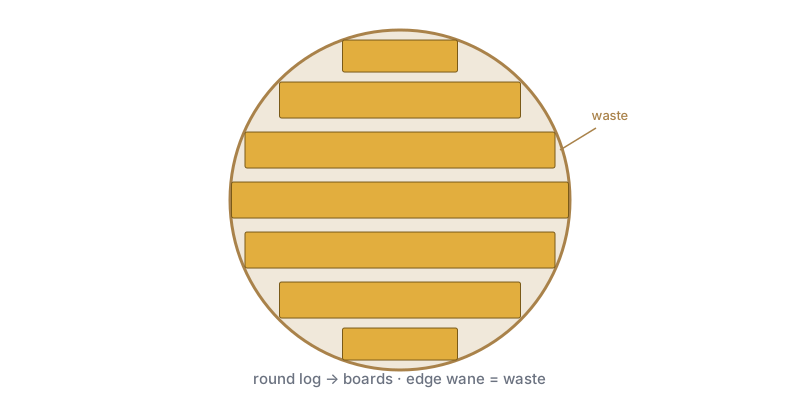
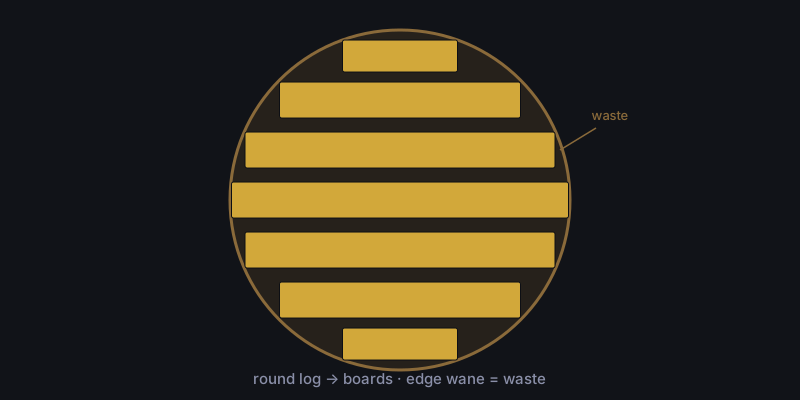
Each product is laid through-and-through across the log circle. The table ranks them by indicative value, with pieces, m³ yield and value per log-m³. The highlighted row is the most valuable cut for this exact log.
Re-rank as prices move
When the beam market softens or pallet wood spikes, change the prices and the ranking updates instantly. That is the daily decision a mill makes by feel — now backed by a number.
Read This Before You Trust the Profit Number
Yield is reliable. Value is indicative. The cubic metres and piece counts come from geometry and are dependable. The money figure is only as good as the prices you enter — and it deliberately ignores internal defects, knots and visual grade. In real lumber, grade is the dominant price driver, and you cannot see a knot until you open the log. Use this tool to rank options and frame the decision, not to issue a quote.
This honesty is the point. A calculator that promised an exact profit from outside geometry alone would be lying — the spread between a clear C24 beam and the same beam downgraded to pallet stock can be large, and it hides inside the log. What a geometry-based ranking can do well is tell you that, at today’s prices, boards beat beams from this diameter — and that is usually the decision that was being guessed.
Who This Is For
Small and medium sawmills
The mill that runs on experience and a phone. You know your diameters and your prices; what you don’t have is a fast way to test “beams vs. boards vs. pallet wood” before the saw runs. This turns that into a ten-second check per log class.
Woodlot owners and timber merchants
Deciding whether a stack of logs is worth more sold round or sawn — and into what. Enter the dominant log size and your local prices to see the sawn-value ceiling before you commit.
Estimators and buyers
Sanity-check a log purchase: at the diameter on offer and the prices you can sell at, what is the realistic sawn value per cubic metre? The value-per-log-m³ column is built for exactly that.
Frequently Asked Questions
The questions below are also answered in the structured FAQ at the bottom of this page.
- Does it handle taper? It uses the small-end diameter as the usable cylinder, which is the conservative, correct basis for full-length boards. Taper gain toward the butt is intentionally not counted as bonus yield.
- Can it do cant sawing or mixed patterns? Not yet — the first version ranks single-product through-and-through cuts, which is the cleanest way to compare product value. Cant-plus-sideboards and true mixed patterns are on the roadmap.
- Is my data sent anywhere? No. The calculator runs entirely in your browser; prices and log sizes never leave your device.