Paver Calculator — Layout, Cut Pieces & Order List
Draw your patio, pick a paver and a pattern: see the layout with every cut piece numbered, which paver each piece comes from, kerbs and the order list.
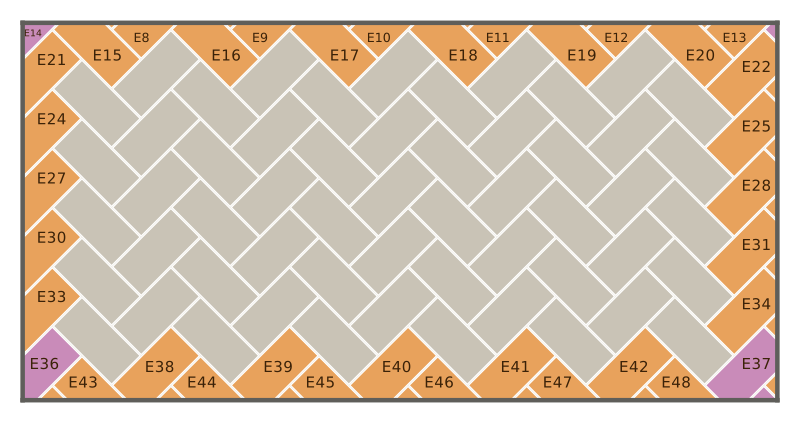
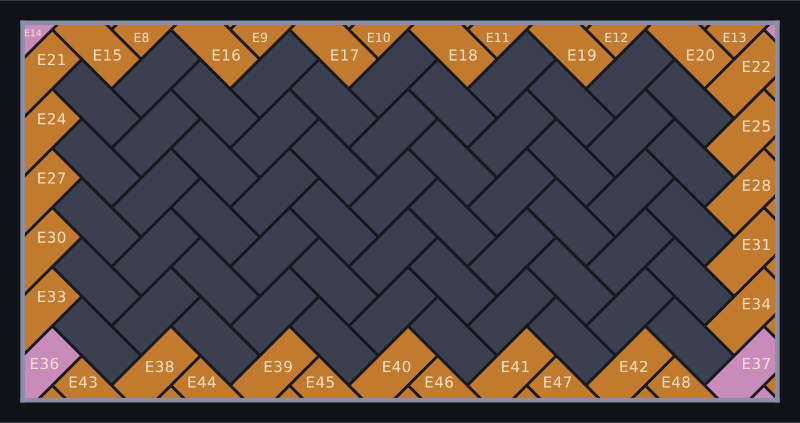
A paver count from square footage tells you roughly how many pavers to buy. It does not tell you where the cuts fall, how thin the edge pieces get, or that two slanted herringbone pieces can come from one paver. That is the difference between a quantity and a plan.
This calculator lays your pattern over your area, numbers every cut piece, shows which paver it is cut from, and turns that into an order list with the kerb stones.
The example on load is a 20 × 15 ft L-shaped patio with an 8 × 6 ft notch at the house, your own 200 × 100 mm paver without a joint, 45° herringbone and a 3 mm saw cut. It comes out at 1,081 whole pavers and 172 cut pieces; 43 pavers each give two cut pieces, so you buy 1,210 pavers — 3.3 % waste. The four edges away from the house take 18 kerb stones of 1000 × 80 mm for a 56.8 ft run.
How do you use this calculator?
Draw the area
Rectangle or L-shape by its sizes, or any shape as a list of sides: each line a length and the turn at its end (90 left, -90 right). The calculator checks that the outline closes. Add a manhole by size and position. The outline is drawn above the fields with its side lengths, and the manhole with its position, as you type.
Pick the paver
Choose your market and a product: the sizes come from the manufacturer’s datasheet. Or enter your own paver length, width and joint.
Pick the pattern and the edges
Stack, running bond, herringbone or basket weave, along the edge or at 45°. For each edge choose kerb or wall — the house side usually needs no kerb.
Read the plan and order
Press Calculate. The plan shows every cut piece with a number; “Which piece comes from which paver” shows the cuts on each paver; the order list and a CSV are below.
How does it lay the pattern?
On the laying grid, not on the paver size. Pavers are made slightly smaller than the grid they are laid on; the difference is the joint. A paver with a 198 × 98 mm stone lays on a 200 × 100 mm grid. The calculator places the grid and cuts the stone, so the count and the cut sizes are both right.
From the best start point. Where the pattern starts decides how the edges are cut. The calculator tries a fixed set of start points — the two symmetric ones on each axis (a joint on the centre line, or a paver centred on it), one aligned with the corner, and a grid across one pattern repeat — and ranks them by these rules, in this order:
- fewest pieces narrower than your minimum, if you entered one;
- fewest pieces or trims too thin to cut;
- both opposite edges cut alike;
- fewest edge pieces under two-thirds of a paver;
- fewest pavers needed.
This is a preference, not a guarantee: on some shapes a narrow piece cannot be avoided, and the plan then lists the narrowest pieces.
The same input always gives the same plan.
Which paver does each cut piece come from?
Most edge pieces do not need a paver of their own.
- Rectangular pieces — along an edge parallel to the pattern — are packed onto whole pavers the way parts are packed onto a sheet, with your saw cut between them.
- Slanted pieces — herringbone or 45° layouts meeting a straight edge — are cut with one straight line. Two of them fit one paver when the paver can be turned so their cuts run the same way and both pieces, plus the saw cut, fit along it. The calculator checks this exactly and pairs as many as possible.
- Half stones. If the paver comes with a factory half stone, a piece that is a half is laid as a half stone instead of being cut.
- Everything else — a piece cut twice, or around a corner — gets its own paver, and the calculator says how many.
“Which piece comes from which paver” draws each paver that gets cut, with its pieces and the cut lines, numbered like the plan.
Kerbs and the order list
For every edge marked as kerb, the calculator runs the kerb along the outside of the area. At an outside corner one kerb runs on past the other; at an inside corner it stops short — that is exact for square corners, and a corner at another angle is flagged. Whole kerb stones go first; the leftover lengths are cut from as few kerbs as possible.
The order list counts pavers, half stones and kerbs. Pallets and weight appear only when the manufacturer’s datasheet states them; otherwise the line says “not on the datasheet”. Each catalogue product shows which datasheet it comes from and when we read it.
The calculator never makes up a size. If a datasheet gives only the stone size or only the laying size, it asks for your joint instead of assuming one.
What are the rules in your market?
The calculator plans the paving layer. Base, bedding, joints and kerbs are set by the standards and by the manufacturer’s laying instructions; we link them and do not copy them.
- US — CMHA PAV-TEC-002-22 “Construction of Interlocking Concrete Pavements” (formerly ICPI) and ASTM C936 for concrete pavers.
- UK — BS 7533-102:2025, installation of pavements using modular paving units.
- Germany — DIN 18318:2019-09, ZTV Pflaster-StB 20 and M FP 2024 (FGSV).
It does not design the base or check the paving for traffic loads. Ask the manufacturer or your contractor which build-up your ground and use need.
Common mistakes
Counting from the stone size. The stone is smaller than the grid it lies on. Count from the stone and you buy too many; cut to the grid and every piece is too big.
Starting the pattern in a corner by habit. It looks tidy at that corner and leaves a thin strip at the far edge. Let the start point move until both edges are cut alike.
Adding a flat 10 % for herringbone. The real figure depends on the area and on how the slanted pieces pair up. Measure it, then add your own reserve for breakage.
Cutting a half you could buy. Many paver ranges include a half stone. A factory half has clean edges and saves a cut.
Forgetting the kerbs at the corners. An outside corner needs one kerb to run on past the other; an inside corner one less. On a long edge that is one more cut stone.
When should you not use this?
For curved edges and circles — the outline is straight sides only, and curved pieces are cut on site. For interlocking shapes, hexagons, fan or random patterns, which come in a later round. And whenever the question is how deep the base has to be — that is the standard’s and the manufacturer’s call, not a layout’s.